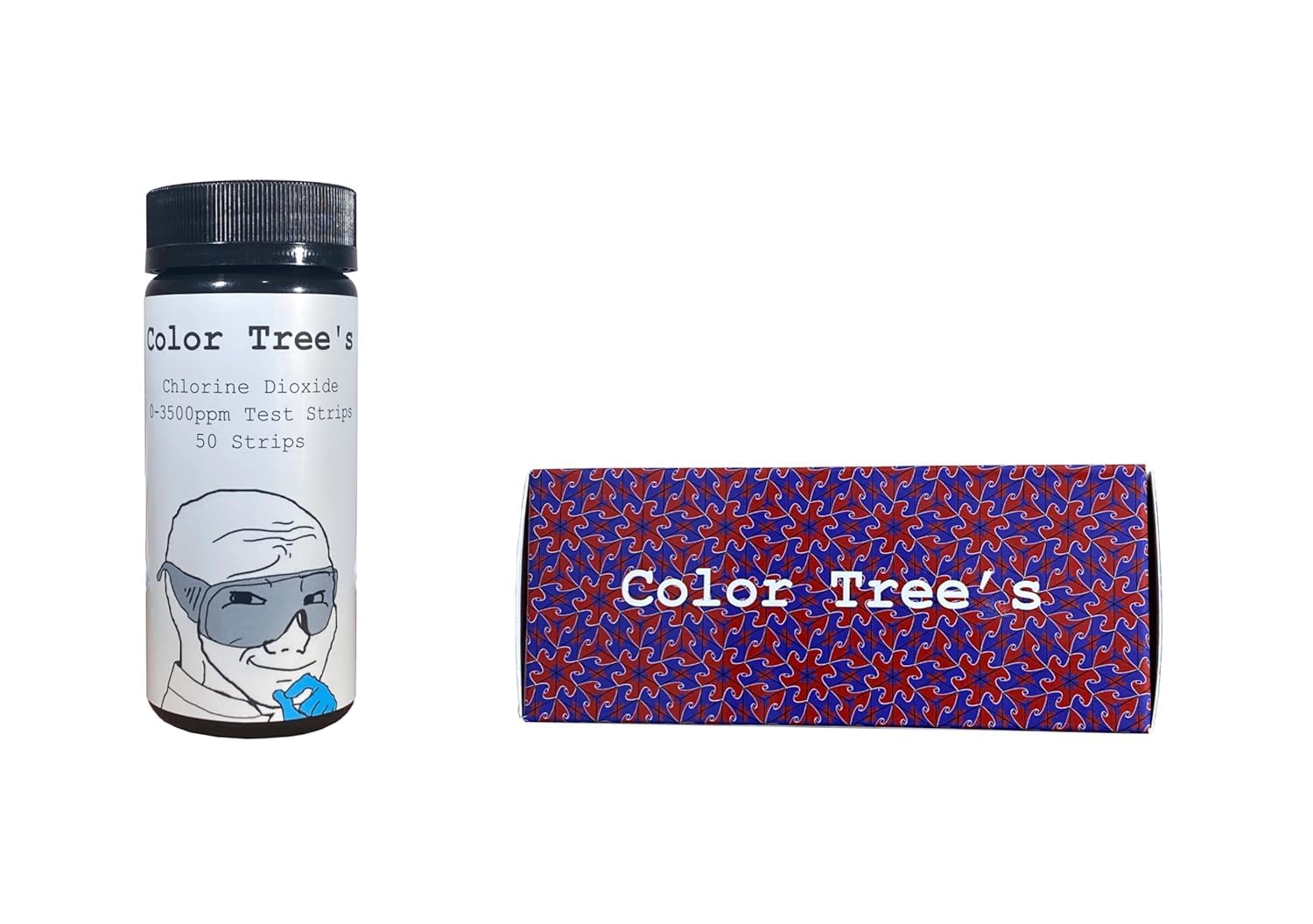
Color Tree 3000ppm Chlorine Dioxide Test Strips Review: High-Range Testing for DIY CDS Users
If you work with concentrated chlorine dioxide solutions—especially in DIY CDS (Chlorine Dioxide Solution) setups—you probably already know that standard low-range test strips top out at around 500 ppm or less. Color Tree’s 3000ppm test strips aim to fill that gap, offering a range from 0 to 3000 ppm for people who need to measure higher concentrations without diluting samples. I’ve been using these for a few weeks now, and they do what they say, but there are a few things worth noting before you buy.
These strips are designed for direct immersion into a solution for a few seconds, then you wait about 10–15 seconds for the color to develop. The pad shifts through a series of yellows and oranges, matching a color chart on the bottle that covers 0, 10, 50, 100, 200, 500, 1000, 2000, and 3000 ppm. For anyone making or diluting high-strength ClO2, this saves the hassle of doing serial dilutions just to get a reading. The strips are also marketed for OEM customization, meaning bulk buyers can have their own branding added, but for individual users, you just get a standard bottle of 50 strips.
In real use, the strips are reasonably consistent. If you test a fresh 3000 ppm reference solution, the pad hits the darkest orange on the chart fairly reliably. However, color matching in the mid-range—like between 200 and 500 ppm—can be a bit subjective, especially under artificial light. The difference between 200 and 500 is a subtle shift from pale yellow-orange to a slightly deeper shade, and if you’re not careful, you might misread by a couple hundred ppm. I found it helpful to use natural daylight or a white LED lamp to get more consistent readings.
One limitation is that these strips are not for low-concentration work. If you’re testing drinking water or sanitizer solutions below 10 ppm, you’d be better off with a standard 0–500 ppm strip or a colorimeter. The 3000 ppm range compresses the lower end, so readings under 50 ppm are essentially just “below 50” with no precision. Also, the strips have a shelf life—like most test strips—and exposure to humidity or sunlight can degrade them faster than expected. I keep the bottle tightly sealed with a silica gel pack inside, which seems to help.
Compared to digital meters or titration kits, these strips are far cheaper and more portable, but they lack the precision of a photometer. A digital meter can give you exact ppm to within a few percent, but it costs several hundred dollars. For most DIY CDS users who just need a ballpark figure—like is it around 1000 or 3000?—these strips are a practical compromise. If you need lab-grade accuracy for commercial or regulatory compliance, you’ll want a different tool.
Who are these for? They make sense for homebrewers making CDS for water treatment or experimental uses, especially if you’re working with concentrated generators and need quick checks. They’re also fine for small-scale industrial or agricultural applications where high-range spot checks are sufficient. But they are not ideal for precise dosing in medical contexts, for testing low-concentration solutions, or for anyone who needs detailed documentation of exact ppm values. The color chart’s resolution is just too coarse for that.
On the downside, the strip material feels a bit flimsy compared to some brand-name lab strips. The paper backing is thin, and if you leave it in the solution too long, it can start to disintegrate at the edges. I’ve also noticed that the color development time is short—if you wait more than 20 seconds, the pad starts to darken further, throwing off the reading. A timer helps. Overall, for the price and the niche they serve, these strips are a decent tool. Just know their limits and match them to your actual needs.