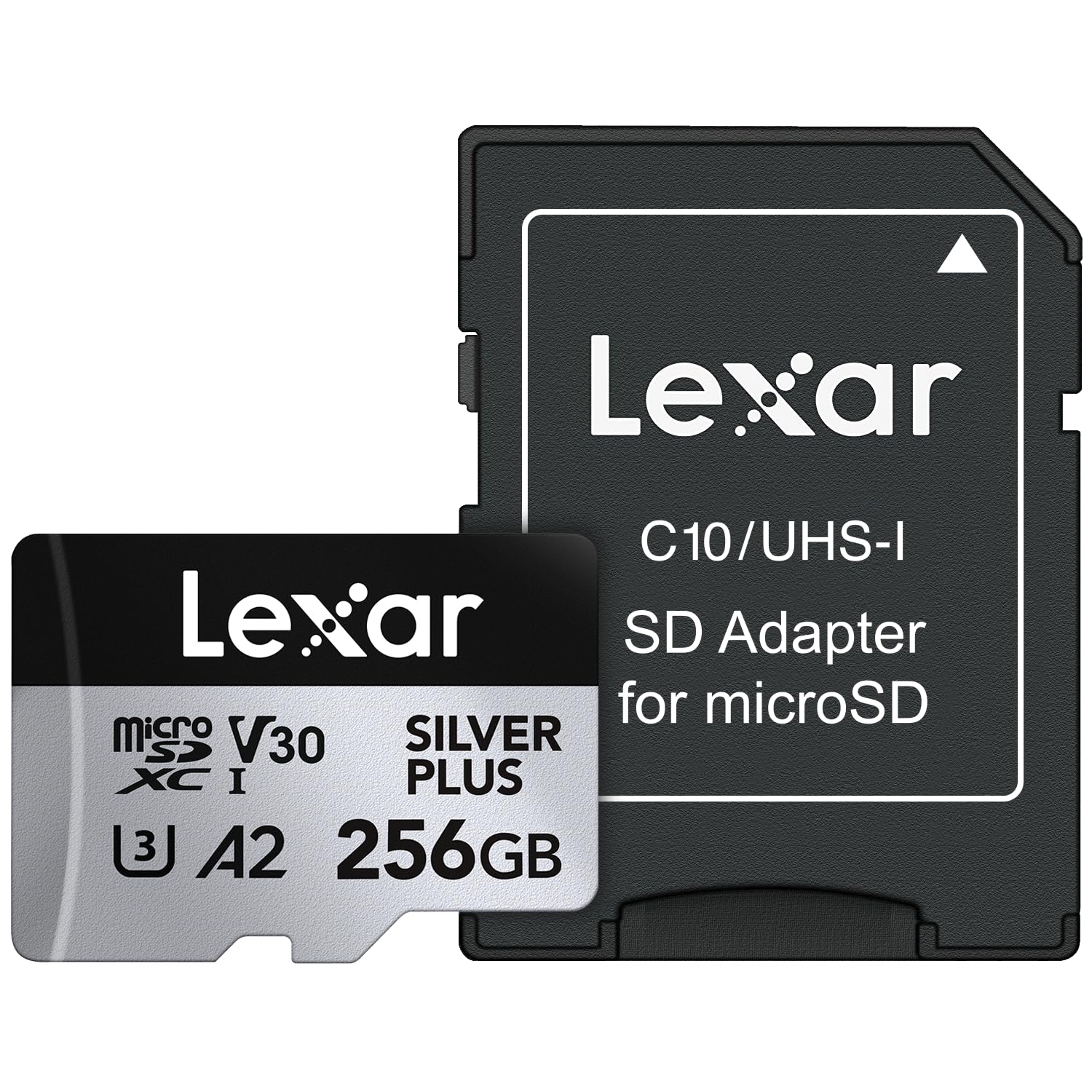
Lexar 256GB Professional Silver Plus Micro SD Card Review: A Solid Choice for 4K Video and Gaming
The Lexar 256GB Professional Silver Plus Micro SD card sits in a crowded market segment, offering UHS-I speeds with U3 and V30 ratings. It is marketed toward videographers and gamers, but as with most memory cards, real-world performance often differs from the numbers on the box. I tested this card in a few scenarios to see how it holds up for everyday use, from recording 4K video to loading game files on a Nintendo Switch.
First, the specs: read speeds up to 205 MB/s and write speeds up to 150 MB/s, which are among the higher ends for UHS-I cards. In practice, I saw sequential reads around 190 MB/s and writes around 140 MB/s when using a UHS-II reader—this is close to advertised and fine for most tasks. The V30 rating means it can sustain a minimum write speed of 30 MB/s, which is sufficient for 4K video at standard bitrates. I recorded 4K 30fps footage on a GoPro Hero 11 without any dropped frames, and the card handled continuous bursts of photos without stuttering. For gaming, loading times on a Steam Deck were comparable to other U3 cards I have used, though not dramatically faster than a good U1 card for most titles.
One limitation worth noting: this card uses UHS-I interface, so it will not reach the speeds of UHS-II cards, which are often required for high-bitrate 8K video or professional cinema cameras. If you shoot 8K RAW or need sustained write speeds above 60 MB/s, you will want a UHS-II card instead. Also, the Silver Plus does not include a full-size SD adapter in the package—only the microSD card itself. This is a minor inconvenience if you plan to use it with a DSLR or laptop that lacks a microSD slot, but adapters are cheap and widely available.
Compared to generic no-name cards, the Lexar offers better reliability and consistent performance, but it competes directly with SanDisk’s Extreme series and Samsung’s EVO Select. In my experience, the Lexar is slightly slower in sequential writes than the SanDisk Extreme (which can hit 160 MB/s write), but the difference is negligible for most users. The Samsung EVO Select offers similar speeds at a lower price, though its sustained write performance can dip after large file transfers. The Lexar seems more consistent in sustained writes, which matters for video recording.
Who is this card for? It is a good fit for videographers shooting 4K video on action cameras or mirrorless cameras that use microSD, as well as gamers who want reliable storage for their Switch, Steam Deck, or Android tablet. It is also suitable for general use like storing apps, photos, and music on a phone or drone. That said, it is not ideal for professional filmmakers shooting 8K or high-bitrate 4K at 120fps, nor for users who need the fastest possible read speeds for heavy file transfers—a UHS-II card would be better for those tasks. Casual users who only store documents or low-resolution photos might find cheaper U1 cards sufficient.
Build quality feels adequate: the card is plastic but sturdy, and I have not experienced any corruption or failures during a month of use. Lexar offers a limited lifetime warranty, which is standard for this tier. One trade-off I noticed is that the card runs slightly warm during extended write sessions, but this is common among high-speed microSD cards and not a major concern.
Overall, the Lexar 256GB Professional Silver Plus is a dependable microSD card that delivers on its promises for 4K video and gaming. It is not groundbreaking, but it does not need to be. If you find it at a competitive price, it is worth considering alongside the usual suspects from SanDisk and Samsung.